The UAP Science Advisory Council
This entry is not a sighting. This case file covers what witnesses reported, the official narrative, and a two-pass assessment with its evidence tier.
What did witnesses see at Washington?
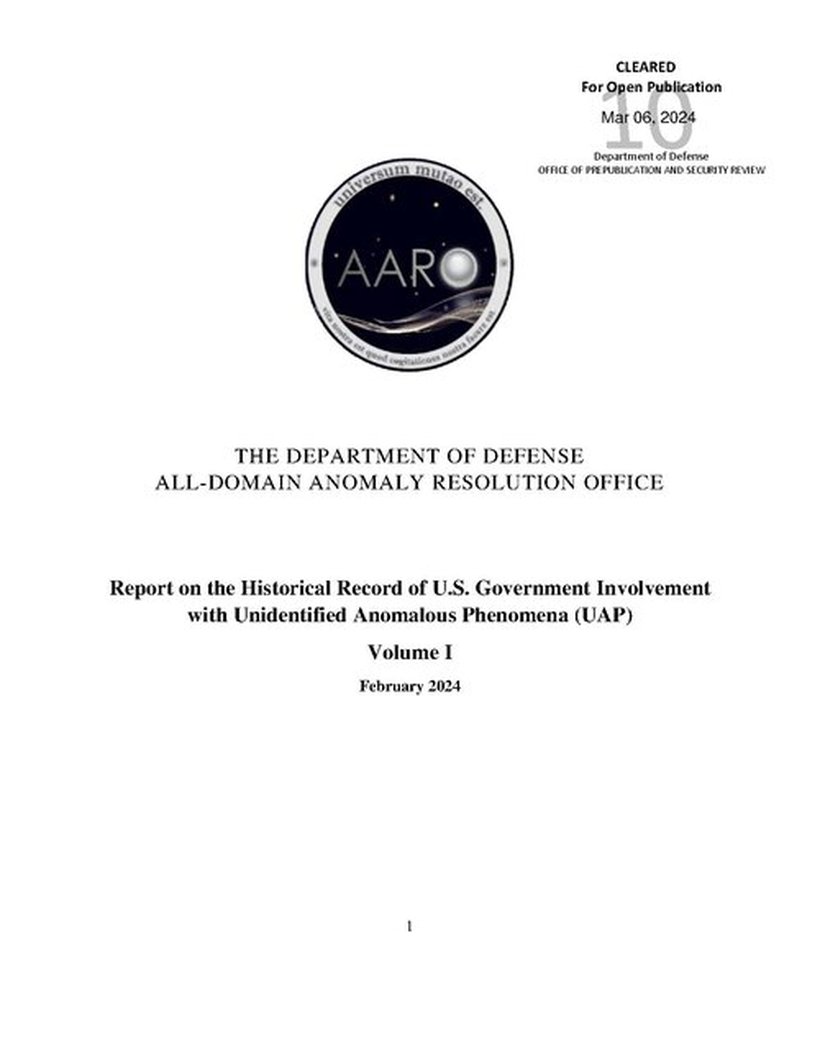
This entry is not a sighting. It is an institutional development inside the United States government's response to UAP, and it belongs in the archive because it changes who is allowed to look at the data. On 13 June 2026 the Harvard astrophysicist Avi Loeb published, on his own Medium page, the formation of a new "UAP Science Advisory Council." Loeb wrote that over the previous week he had been "tasked" by "the White House, AARO, the Office of the Director of National Intelligence (ODNI), the FBI, and all Intelligence Community members" to "create a research team of scientists who will serve on this council." Four days later, on 17 June 2026, the trade outlet DefenseScoop confirmed the council's existence and reported its reporting line.
Loeb named the full roster in his announcement. The council, as he listed it, is: Prof. Carol Cleland (anomaly identification); Dr. Richard Cloete (data analysis and AI tools); Dr. Omer Eldadi (data management, AI, and human psychology); Dr. Tim Gallaudet (oceanography); Prof. Robin Hanson (statistics and economics); Ross Howard (communication); Dr. Kevin Knuth (physics and instrumentation); Ben Lamm (oceanography and biology); Dr. Devesh Nandal (numerical analysis and astrophysics); Prof. Garry Nolan (molecular biology and materials science); Dr. Michael Shermer (the study of anomalies); Dr. Peter Skafish (anthropology); Prof. Matthew Szydagis (instrumentation and data collection); and Dr. Jennice Vilhauer (quantitative psychology). Loeb called it "an amazing A-team of exceptional scientists" and explained the breadth of disciplines by saying that "since UAPs are physical objects that interact with humans, the council includes members with expertise in physical sciences as well as psychology and biology."
The membership is notable for who is in the room. Tim Gallaudet is a retired U.S. Navy rear admiral and a former acting administrator of NOAA. Garry Nolan is a Stanford immunologist who has spent years studying claimed UAP materials. Matthew Szydagis and Kevin Knuth are working physicists in instrumentation and detector design, the kind of people who build sensors rather than interpret anecdotes. And, pointedly, the panel also seats Michael Shermer, the founder of Skeptic magazine and one of the best-known professional debunkers in the country. A council that contains both committed researchers and a career skeptic is not a believers' club; that mixture is the most interesting thing about the line-up.
What is the official explanation?
The council's authority is advisory, and its place in the chain is specific. Loeb stated that "the goal of the council is to advise the U.S. government on how to resolve the nature of UAP," and DefenseScoop reported that the council sits beneath a higher-level "UAP Governance Board," an interagency body established by ODNI, the FBI and the Department of Defense to provide, in an ODNI official's words, "guidance, recommendations and coordination at the interagency level." The science council advises the All-domain Anomaly Resolution Office (AARO) inside that framework. Crucially, DefenseScoop reported that the data shared with the council will be unclassified. An unclassified mandate is a double-edged sword: it lets the scientists publish and lets the public follow along, but it also means the council is not, by design, being handed the classified holdings that whistleblowers claim exist.
The council did not appear in a vacuum. It is the institutional sequel to the Trump administration's PURSUE disclosure initiative (the Presidential Unsealing and Reporting System for UAP Encounters), under which the Department of War released three tranches of declassified UAP records in May and June 2026. Loeb explicitly anchored the council's urgency to the third release, and in particular to a 5 June 2026 letter signed by AARO director Dr. Jon Kosloski describing an October 2023 episode in which trustworthy law-enforcement witnesses watched an orange "mother" orb appear to launch smaller red orbs, and in which AARO concluded it could not explain roughly 40 percent of what was reported. By Loeb's account the three releases had drawn "more than a billion views" online. The council is, in part, the government's attempt to convert that attention into method.
ENRICHMENT, 29 July 2026. The Harvard Crimson published a reported piece on 11 July 2026, based on an on-the-record interview with Loeb, that fills in how the council was actually assembled and adds several facts that were not public in June. Loeb told the paper that a representative of the Office of the Director of National Intelligence came to his home with the request roughly a week before the government released its latest tranche of declassified files, and that government approaching scientists in this way "doesn't happen very frequently." He said the White House gave him a "free hand" in selecting members and never vetoed a pick, that he sought young researchers without "baggage," and that he received more interest than the council could seat: "I could have made a committee that is five times bigger."
The roster is both larger and more concentrated than the June announcement showed. Of the 18 publicly named members, 12 have ties to Harvard: five faculty and staff directly affiliated with the University, three postdoctoral researchers, and four research affiliates of the Galileo Project, which Loeb directs and which is housed in Harvard's Department of Astronomy. The council grew from five members to 18 over several weeks. Galileo Project postdoc Regina Sarmiento was named in the initial announcement and then removed; Loeb said she withdrew over the short-term nature of the position. Two astrobiologists, Jacob Haqq-Misra and Ravi Kopparapu, had been added without public announcement, and Tim Dalrymple, president of the Templeton Foundation and a former Christianity Today chief executive with a Harvard doctorate in religious studies, was awaiting final approval. Loeb confirmed he picked Shermer deliberately as the group's in-house doubter, so that any consensus would hold "beyond any reasonable doubt."
Three structural facts from that interview matter more than the personnel. First, the council has no budget at all and membership is voluntary and unpaid: "There is no support we have, we don't have a budget." Second, the council does not communicate directly with the White House or ODNI; everything is routed through Loeb himself and through the parallel UAP Governing Board, whose membership is not public. Third, and most concretely testable, the council has asked the Pentagon to declassify 50 specific items and, as of the Crimson's reporting, had received no response. That last point is the measurable one. An advisory body with no budget, no direct channel and no answer to its first substantive request is a body whose influence remains entirely unproven, and the 50-item request is the cleanest yardstick the public has for judging whether this council does anything. A partial answer to that yardstick has since emerged, and it is not a refusal on the merits. In an interview with Fox News Digital published on 11 July 2026, Loeb said he had asked the Pentagon and other agencies for 50 videos, images and other documents relating to known UAP incidents, that the material had not been handed over, and that the custodian agencies were citing national security concerns. His account of the reason given is narrower than a blanket refusal and worth recording: "It is not so much the targets that are the issue. It is that the sensors that were used were for national security purposes. The U.S. government does not want to reveal to adversarial nations the kind of sensors being used. So, that is the main obstacle right now." If that is the genuine obstacle then it is a solvable one, because sensor characteristics can be withheld or degraded without withholding the observation itself, and a council that asks for the observation rather than the instrument would be the obvious thing to watch for next. Loeb also said he did not inform Harvard's leadership before agreeing to serve, at a time when the University was in active litigation with the White House. Council member Michael Shermer, for his part, told the Crimson he hoped Loeb's "connections to insiders high up may get us some good materials," naming "documents, files, videos, photographs," which is a candid acknowledgement that the unclassified-only mandate described above is not what at least some members are hoping for.
What did the witnesses think it was?
The clearest statement of intent comes from Loeb himself, who is both the council's chair and, conveniently for this archive, a prolific public writer. In a transcript he posted of his 17 June Fox & Friends interview, he laid out the two ways to read AARO's own admission. "There are two possible interpretations," he said. "If you are down to Earth and you say I'm a realist, which is pretty much the approach that the intelligence agencies take, you must admit that there are objects that are potentially produced by adversarial nations and that we are not aware of. And they are found near sensitive sites of strategic assets, so that's a major national security concern."
He pressed the prosaic case first, naming the candidate explicitly: "There needs to be more research and more funding going to figuring out whether we are being spied upon by adversarial nations like the Chinese. We shut down a Chinese spy balloon. The question is, are there drones with very special technologies that we are not aware of?" Only after that did he allow the other possibility: "The icing on the cake is, after looking into that, if we end up concluding that some UAPs are not human made, and instead have an extraterrestrial origin. That will be the biggest discovery ever made by humanity." His framing of the council's discipline was a borrowed sports line: in his words, "we must keep our eyes on the orbs, not the audience."
Is the UAP Science Advisory Council real? The two-pass assessment
Pass one: how this could amount to very little. The United States has convened blue-ribbon science panels on UAP before, and the founding example is a cautionary one. The Condon Committee at the University of Colorado was funded by the Air Force in the late 1960s precisely to produce a scientific verdict, and it returned a recommendation that the subject did not merit further study, a conclusion that closed Project Blue Book and chilled academic interest for a generation, even though the report's own case files contained genuine unknowns. An advisory council with no subpoena power, an unclassified-only mandate, and no budget line of its own can easily become a place where the question is seen to be addressed without anything being resolved. The presence of a celebrated skeptic on the roster can be read two ways, and the deflationary reading is that the panel is structured to manage expectations. It is also fair to note that the council's chair is among the most media-present scientists alive, and that "more than a billion views" is the kind of metric that produces committees as much as committees produce findings.
Pass two: why it is not nothing. The membership is heavier on hard instrumentation than any prior official UAP effort that has been made public. Detector physicists, a former NOAA administrator and Navy admiral, and a materials scientist are exactly the people you would recruit if the goal were to collect calibrated data rather than to relitigate old film. An unclassified remit, for all its limits, is the precondition for peer review: results the council can publish are results the rest of the scientific community can check. And the council exists downstream of an official document, the Kosloski letter, in which the government itself wrote that it could not explain 40 percent of a specific, recent, multi-witness event. That admission is the apparatus conceding a real residue, and standing up a science board to chase it is a more honest response than the historical pattern of debunk-and-dampen. No official narrative resolves what UAP are, and this council does not claim to; it is filed here as Unknown. What it is, unambiguously, is a verified change in how the U.S. government intends to study the question, and whether it produces data or merely produces meetings is the thing later runs of this archive will be watching.
ENRICHMENT, 28 July 2026. The council's chair has now set out his own terms in public. In a post dated 19 July 2026, Avi Loeb gave two reasons for taking the job: "As a U.S. citizen, I feel obligated to help ODNI and the Pentagon fulfil their mission of protecting national security," and the scientific stake, that "if one in a million UAP happens to have a non-human origin, this will constitute the biggest cosmic discovery ever made by humanity." He also disclosed the council's operating shape, which answers several of the questions left open above. The council has submitted requests for more than fifty items of information concerning past incidents. It processes ONLY unclassified material, with classified access running through the UAP Governing Board and the relevant agencies rather than through the council itself. And its analysis is committed to public release through its own site at uapsac.com.
That last point matters for how this case should be read going forward. An advisory body that publishes its own findings can be checked; one that reports only inward cannot. Loeb's stated framing is also worth recording verbatim because it is close to this archive's own standard: "The council is not starting with a conclusion. Unknown does not mean extraterrestrial, but it also should not be explained away without evidence." None of this resolves the pass-one worry that an unclassified-only panel with no subpoena power can be a way of appearing to address the question. It does mean the council has made specific, checkable commitments, and the honest test is whether the fifty-plus information requests are answered and whether the promised public analysis actually appears.
Sources
- avi-loeb.medium.com/a-uap-science-advisory-council-to-the-u-s-f7262e57b0df
- defensescoop.com/2026/06/17/new-science-advisory-council-forms-to-help-us-government-resolve-the-uap-mystery/
- www.cbsnews.com/news/ufo-files-pentagon-3rd-release-documents-videos/
- avi-loeb.medium.com/why-i-agreed-to-lead-the-uap-science-advisory-council-for-the-u-s-government-dde90610dfa2
- uapsac.com/
- www.space.com/space-exploration/search-for-life/white-house-appoints-harvard-astronomer-avi-loeb-to-lead-new-ufo-study-group
- www.thecrimson.com/article/2026/7/11/avi-loeb-uap-council/
- www.foxnews.com/politics/harvard-astronomer-tapped-lead-white-house-ufo-council-says-us-government-baffled-what-they-are-seeing
More cases from this region: UFO sightings in United States